Compression Standards Determining Visual Fidelity in On-Demand Video Archives
Logan Braun · Aug 8, 2026
Compression Standards Determining Visual Fidelity in On-Demand Video Archives
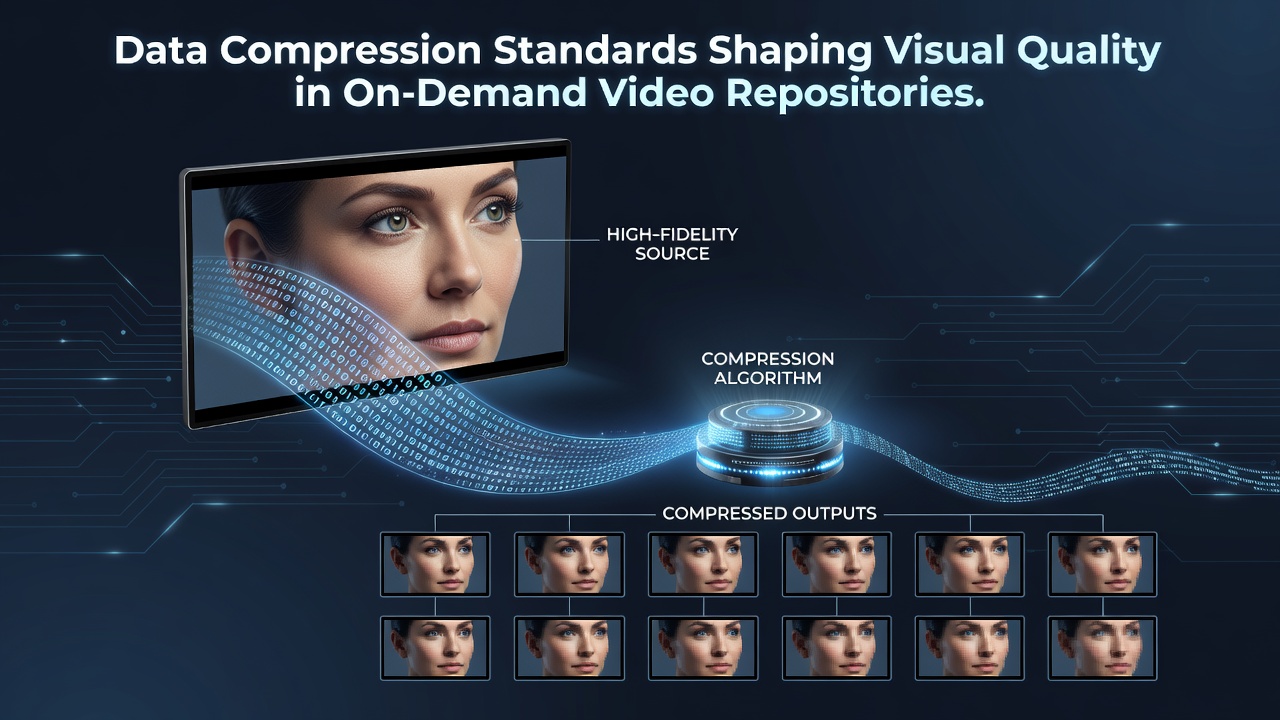
Data compression standards have shaped how visual quality is maintained across on-demand video archives since the early days of digital distribution, and they continue to evolve as content libraries expand in August 2026. These protocols determine bitrates, resolution retention, and artifact reduction while balancing storage demands against transmission efficiency in large-scale repositories that serve millions of simultaneous viewers.
Core Standards and Their Technical Foundations
Standards such as H.264, HEVC, and AV1 each define distinct approaches to encoding that directly influence picture fidelity. H.264 remains widely deployed because it delivers reliable performance across varied network conditions, whereas HEVC improves compression efficiency by roughly fifty percent compared with its predecessor according to ITU documentation. AV1 extends these gains further through royalty-free licensing, and data from industry reports indicate growing adoption rates in major streaming platforms by mid-2026.
Researchers at multiple institutions have measured how each standard handles motion compensation, intra-frame prediction, and transform coding, all of which affect perceived sharpness, color accuracy, and noise levels in archived footage. Observers note that HEVC tends to preserve fine detail in high-motion sequences better than H.264 at equivalent bitrates, while AV1 shows measurable advantages in static scenes with complex textures.
Effects on Resolution and Artifact Management
Visual quality metrics such as peak signal-to-noise ratio and structural similarity index reveal clear differences once content is encoded under each standard. Lower bitrates often introduce blocking, banding, or blurring, yet newer codecs mitigate these issues through adaptive quantization and improved loop filtering. Figures from technical evaluations show that AV1 can maintain acceptable quality at bitrates twenty to thirty percent below those required by HEVC, which matters for repositories that store thousands of hours of 4K and HDR material.
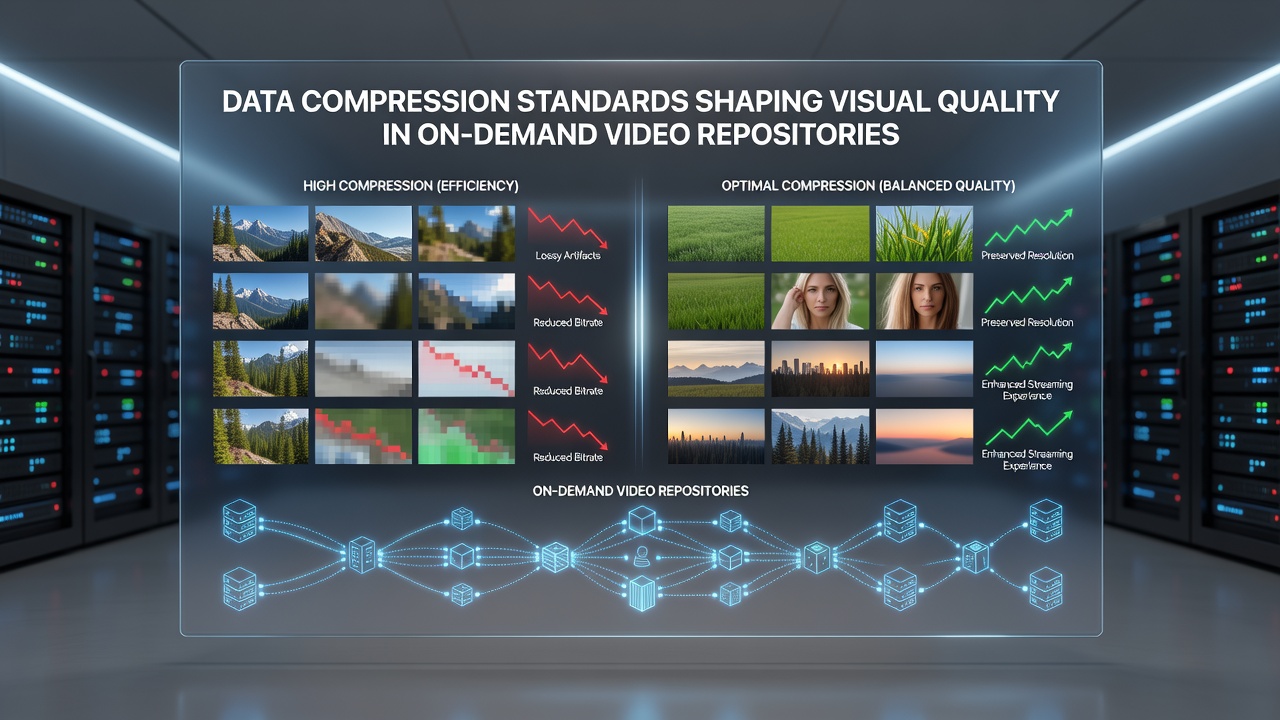
Repositories must also account for device compatibility because older hardware may not decode the latest standards without fallback options. This creates layered encoding strategies where multiple versions of the same title sit side by side, each optimized for different network profiles and display capabilities. Studies from European research consortia confirm that such multi-profile approaches reduce buffering events without sacrificing average visual quality scores across user sessions.
Storage, Transmission, and Repository Scale
Large on-demand archives face constant pressure to minimize storage footprints while preserving perceptual quality, and compression standards serve as the primary tool for achieving that balance. Efficient encoding allows facilities to retain higher-resolution masters alongside delivery copies, supporting both archival integrity and consumer access. Data indicates that switching from H.264 to AV1 across a substantial portion of a library can free up to forty percent of storage capacity, though transcoding workloads increase during the migration period.
Transmission efficiency gains further influence quality because lower required bitrates enable higher resolutions or frame rates within the same bandwidth envelope. Network operators in North America and Asia-Pacific regions report that AV1 streams support 4K delivery more consistently over variable mobile connections than older codecs, and these improvements appear in usage statistics collected through 2026.
Future Developments and Standardization Efforts
Work continues on the next generation of codecs that promise additional efficiency gains beyond current AV1 performance. Standards bodies including the Moving Picture Experts Group and the Alliance for Open Media coordinate testing that evaluates both objective metrics and subjective viewer assessments. Preliminary results shared in technical forums suggest that emerging tools for machine-learning-based encoding could reduce artifacts in challenging content types such as animated sequences or high-dynamic-range material.
Repositories that adopt these advances early gain advantages in cost management and viewer retention, while slower transitions risk quality inconsistencies across their catalogs. International collaboration on interoperability testing helps ensure that new standards integrate smoothly with existing infrastructure.
Conclusion
Compression standards remain central to how visual quality is preserved and delivered through on-demand video repositories, and ongoing refinements continue to shift the trade-offs between efficiency and fidelity. Data from standards organizations and independent evaluations demonstrate measurable impacts on resolution retention, artifact levels, and storage requirements, while adoption patterns observed through August 2026 highlight increasing reliance on royalty-free options such as AV1. These developments shape the technical foundation that supports expanding content libraries and diverse viewer devices worldwide.