Thumbnail Variations Through A/B Testing Enhance Selection Rates for Documentaries in Saturated Markets
Ben Vogel · Aug 20, 2026

Thumbnail Variations Through A/B Testing Enhance Selection Rates for Documentaries in Saturated Markets
Platforms that host extensive libraries of documentary series have turned to systematic A/B testing of thumbnails as a method for improving selection rates, and data from industry analyses indicate that small visual adjustments produce measurable differences in viewer behavior. Researchers at institutions such as the University of Amsterdam have documented how platforms adjust image elements including color saturation, facial expressions, and text overlays, then compare click-through metrics across user cohorts to determine which versions perform better in competitive recommendation feeds.
Mechanics of Thumbnail Testing in Streaming Environments
Teams responsible for content presentation select pairs of thumbnail candidates, assign them randomly to segments of the audience, and track engagement metrics over defined periods, often spanning several days or weeks, while controlling for factors like time of day and geographic location. According to reports issued by the Australian Communications and Media Authority, these controlled comparisons help isolate the impact of thumbnail design from broader algorithmic influences, and results frequently show that thumbnails featuring clearer subject focus achieve higher selection rates than those relying on dramatic but ambiguous imagery.
Documentary series present particular challenges because their subject matter ranges from historical events to scientific investigations, which means thumbnail designers must balance informational accuracy with visual appeal. Observers note that testing protocols now incorporate multivariate approaches where multiple elements change simultaneously, yet the core process remains a comparison of performance data between control and variant groups.
Evidence from Recent Platform Deployments
Figures released in August 2026 by streaming services operating in North American and European markets reveal that refined thumbnails lifted documentary selection rates by percentages ranging from eight to fifteen points in several documented cases. One study conducted across multiple platforms found that thumbnails emphasizing human faces with direct eye contact outperformed landscape or object-focused alternatives, a pattern consistent with earlier findings from media psychology research groups.
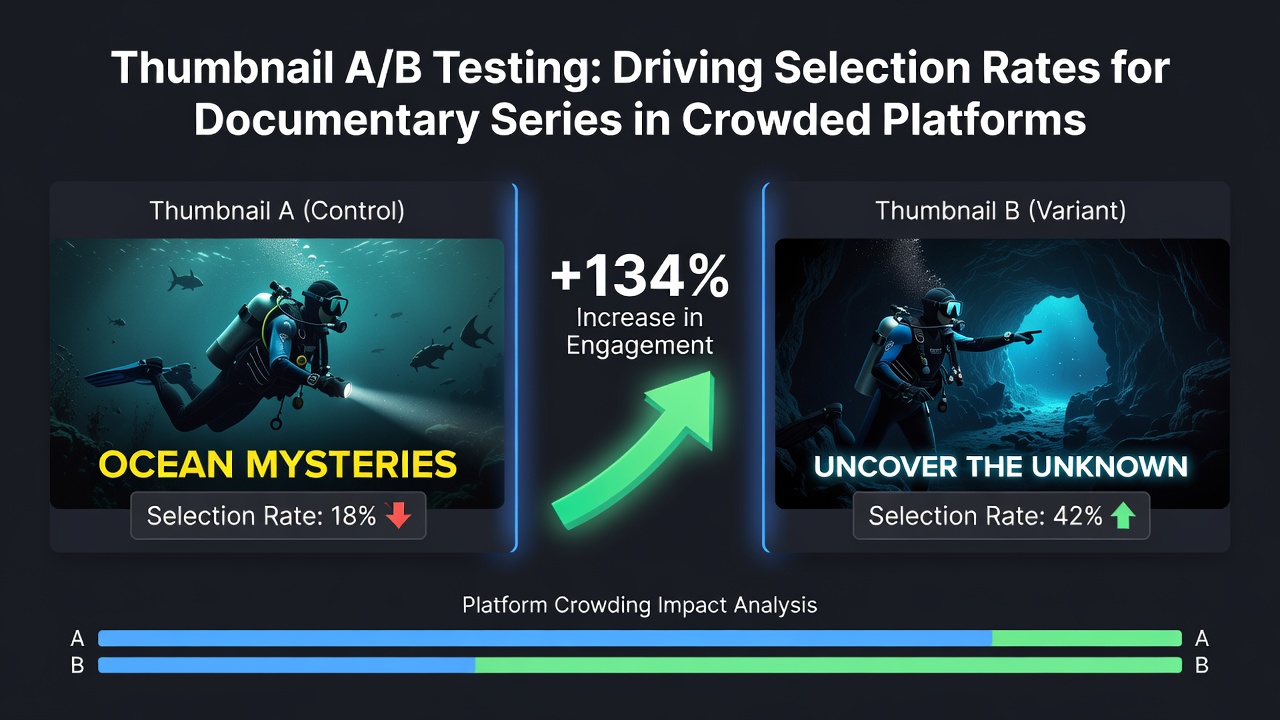
Platforms integrate these tests into larger recommendation systems so that winning thumbnails receive greater distribution while losing variants are retired, and the cycle repeats with new content additions. Evidence suggests that repeated testing cycles allow services to build libraries of effective thumbnail templates tailored to specific documentary subgenres such as true crime, nature, or biography.
Influence of Platform Crowding on Testing Outcomes
When libraries contain thousands of titles competing for attention, the visibility window for any individual series shrinks, which increases the pressure on thumbnail performance. Data indicates that A/B testing becomes especially valuable in these conditions because even modest improvements in click rates can determine whether a series reaches enough viewers to justify continued production investment. Researchers have observed that series in the documentary category benefit disproportionately from optimized thumbnails compared with scripted entertainment, partly because viewers often approach documentaries with more specific topic interests that thumbnails can signal directly.
Analyses from the European Audiovisual Observatory highlight regional variations where European platforms report stronger responses to culturally localized imagery, whereas North American services see broader success with universal emotional cues. These differences underscore the need for geographically segmented testing rather than uniform application of a single winning thumbnail across all markets.
Integration with Broader Content Strategy
Thumbnail testing does not operate in isolation but connects with metadata tagging, subtitle optimization, and algorithmic promotion schedules. Teams coordinate these elements so that a thumbnail proven effective in tests aligns with the descriptive text and suggested viewing order presented to users. Platforms that maintain consistent testing regimens report steadier selection rates across their documentary catalogs, and longitudinal data shows reduced variance in performance between new releases and established titles.
Conclusion
Systematic A/B testing of thumbnails has become a standard practice for platforms seeking to improve selection rates for documentary series amid intense competition. Results compiled through 2026 demonstrate consistent, quantifiable gains when visual elements receive targeted comparison and refinement. Continued application of these methods across varied markets and content types provides platforms with actionable metrics that support more precise content presentation strategies.